
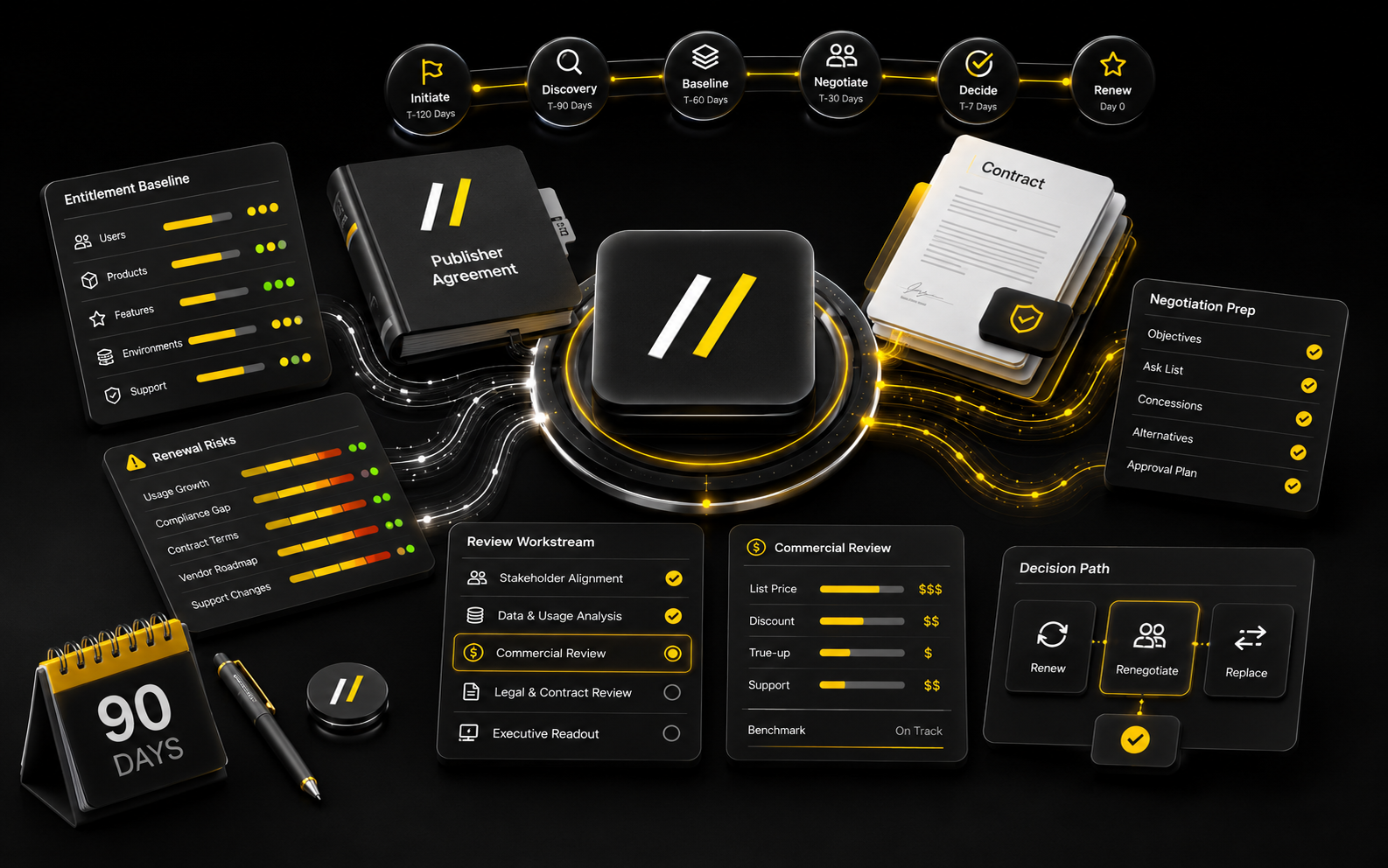
Key takeaways
- A renewal review is not a pricing exercise alone. It is a scope, entitlement, deployment, and support-position review.
- Start at least 90 days before the renewal date; 120 days is better when multiple countries, entities, or product families are involved.
- Your first output should be a renewal review pack containing contract scope, baseline usage, support footprint, and decision options.
- Always compare at least three paths: renew as-is, optimize and renew, and partially restructure or exit.
- If procurement is waiting for numbers before ITAM has clarified scope, the review has already started too late.
Most publisher renewals fail before commercial negotiation even begins. The problem is rarely the quote itself. The real problem is that the organization enters the renewal with an incomplete view of what is in scope, what is being used, who owns the decision, and which commercial levers are actually available.
A good renewal review turns a last-minute procurement event into a structured decision. It tells you what must be renewed, what can be reduced, what needs remediation first, and where the negotiation boundary really sits.
A 5-step scoping model
1. Define contract scope
Map agreements, ordering documents, support schedules, anniversaries, and legal entities. Create one master in-scope inventory.
2. Build a usage baseline
Separate installed, deployed, active, business-critical, and shelfware positions. The point is not volume alone; it is decision relevance.
3. Quantify the support footprint
Identify annual support cost, inactive support lines, unsupported deployments, and products that are being paid for but no longer strategic.
4. Align stakeholders
ITAM, procurement, platform owners, security, finance, and application owners should all sign off on assumptions before negotiation starts.
5. Shape negotiation levers
Decide what can be reduced, re-scoped, bundled, migrated, deferred, or exited. Document fallback positions early.
The 12 data inputs worth collecting
| Input | Why it matters |
|---|---|
| Contract term and renewal date | Defines urgency and commercial leverage window. |
| Products and metrics in scope | Shows which license rules and support policies apply. |
| Current entitlement position | Prevents decisions based on incomplete procurement history. |
| Deployment footprint | Separates theoretical entitlement from actual operational use. |
| Active usage baseline | Highlights candidates for reduction or reclassification. |
| Annual support spend | Quantifies the cost of staying as-is. |
| Business criticality by workload | Prevents low-value workloads from dictating enterprise pricing. |
| Cloud or migration roadmap | Helps avoid renewing cost that will be stranded inside 12 months. |
| Audit exposure or compliance issues | Determines whether remediation must happen before negotiation. |
| Third-party support feasibility | Creates commercial leverage even when not pursued. |
| Stakeholder approval map | Clarifies who can approve reduction, risk, or exception. |
| Target commercial outcomes | Defines what success looks like beyond a discount headline. |
A simple decision model
For each major renewal line, score three scenarios:
- Scenario A — Renew as-is: useful when the estate is stable, mission-critical, and well understood.
- Scenario B — Optimize and renew: remove inactive support lines, rebalance quantities, and align the footprint to actual need.
- Scenario C — Restructure: partial exit, migration, or support model change where the economics no longer justify status quo.
A good review does not chase the biggest theoretical saving. It balances commercial value, operational feasibility, and execution risk.
Common scoping mistakes
- Starting with a discount target before validating scope.
- Letting one publisher quote become the single source of truth.
- Ignoring support cost on products with near-zero active use.
- Skipping application owner sign-off on reduction assumptions.
- Treating every country or legal entity as commercially identical.
What good looks like
By the end of the scoping phase, you should have a renewal pack with quantified spend, validated scope, identified reduction opportunities, a risk register, and named decision owners. That is the point where negotiation becomes faster, cleaner, and materially more defensible.
Quick FAQ
Who is this article for?
ITAM leaders, sourcing teams, software asset managers, procurement stakeholders, and advisors dealing with renewals-related decisions.
Detailed PDF guide
Download the full guide
The web article gives you the concise view. The PDF includes deeper analysis, visual timelines, flowcharts, checklists, and practical review steps.
What should I do next?
Use this article to sharpen your internal brief, then submit an initiative or reach out if your team needs specialist help.
Related insights

How to Reduce Support Spend Across IBM, SAP, Oracle, and VMware
A structured playbook for reducing software support cost without losing control of entitlements, roadmap flexibility, or operational resilience.
Need help turning insight into action?
The exchange is built to help teams structure the problem first—then engage the right expertise.