
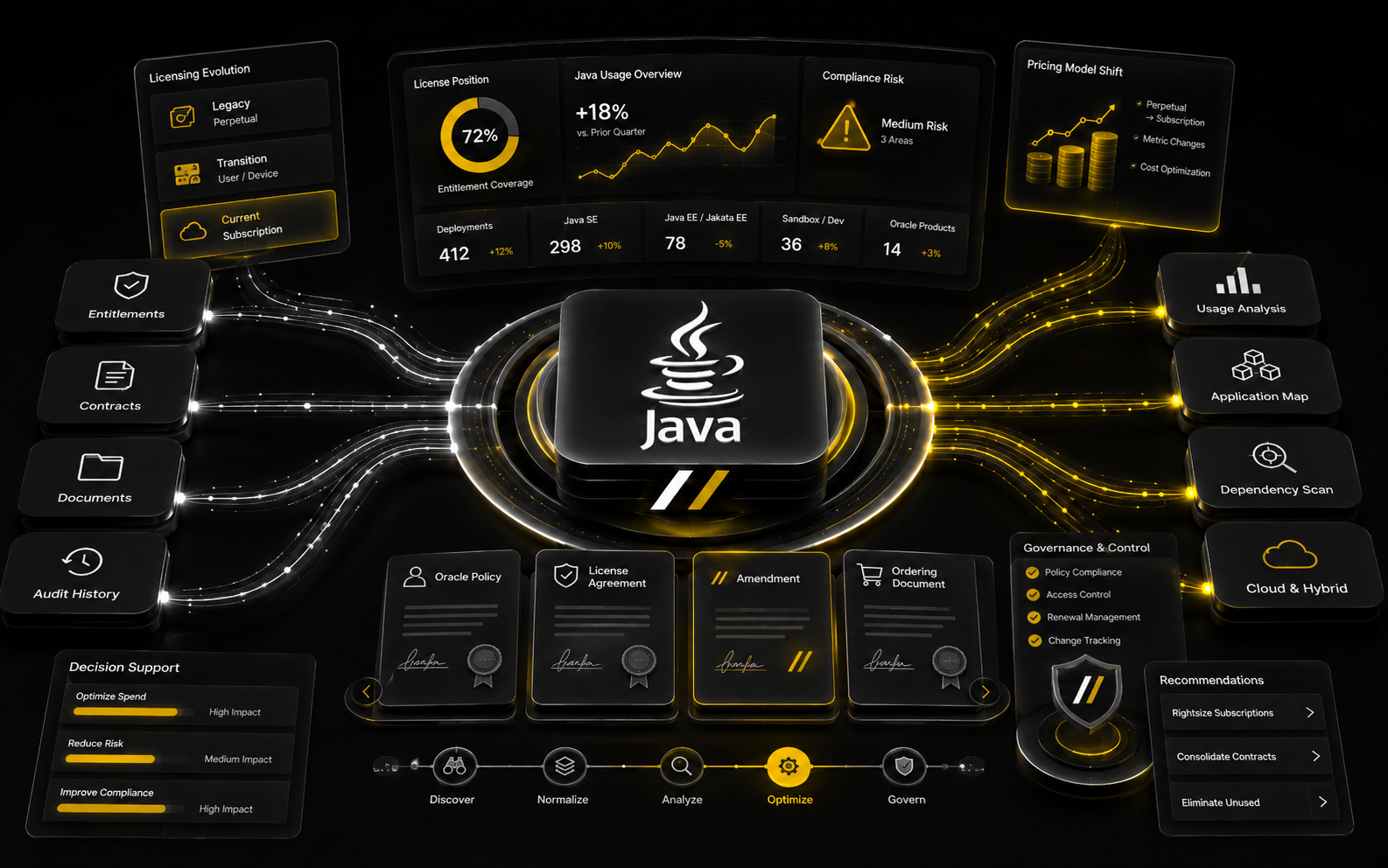
Key takeaways
- Java governance has moved from a developer convenience topic to a commercial control topic.
- The licensing history matters because many organizations still carry old assumptions into current decision-making.
- What changed is not only price mechanics; it is also how organizations must measure and own the estate.
- A Java review should include inventory, versioning, source, deployment context, and commercial intent.
- You do not need to know every version detail to know whether your organization lacks control.
Java changed from something many teams treated as background infrastructure into a topic that can trigger real licensing and governance questions. The challenge is that organizations often remember one era of Java while operating under another.
The short timeline
| Period | What changed | Why it matters |
|---|---|---|
| 2019 | OTN-era change in how many organizations approached downloads and commercial use. | Legacy assumptions often begin here. |
| 2021 | No-Fee Terms and Conditions introduced for specific use patterns. | Added flexibility, but also more nuance. |
| 2023 | Employee-based commercial measurement became a major discussion point. | Shifted the conversation from instances to organizational scope. |
| 2026 | Governance focus intensifies across inventory, sourcing, and commercial oversight. | Control matters more than ad hoc interpretation. |
What a controlled Java position looks like
Inventory
Know where Java exists by version, business owner, and deployment type.
Source tracking
Distinguish Oracle Java, OpenJDK-based distributions, and any approved internal standards.
Commercial intent
Document whether the organization plans to subscribe, migrate, standardize, or segment usage.
Governance
Assign one owner for policy, version control, and exception approval.
The right questions to ask now
- Do we have a trusted inventory, or only estimates?
- Which Java distributions are in use today?
- Where is Java business-critical versus incidental?
- What policy will govern new deployments?
- What commercial model aligns with the actual estate?
Bottom line
Java is no longer a topic to leave unmanaged until renewal time. The history matters because it explains why so many organizations are now trying to rebuild visibility after years of benign neglect.
Quick FAQ
Who is this article for?
ITAM leaders, sourcing teams, software asset managers, procurement stakeholders, and advisors dealing with java-related decisions.
Detailed PDF guide
Download the full guide
The web article gives you the concise view. The PDF includes deeper analysis, visual timelines, flowcharts, checklists, and practical review steps.
What should I do next?
Use this article to sharpen your internal brief, then submit an initiative or reach out if your team needs specialist help.
Related insights

Oracle Licensing Complexity Explained: What Makes It Hard
A practical guide to the Oracle complexity drivers that matter most in enterprise reviews: processor cores, virtualization, Java, options, and support.

SAP Licensing Complexity Explained: The Areas That Matter Most
A practical overview of SAP complexity across named users, digital access, indirect use, engine metrics, and support governance.
Need help turning insight into action?
The exchange is built to help teams structure the problem first—then engage the right expertise.