
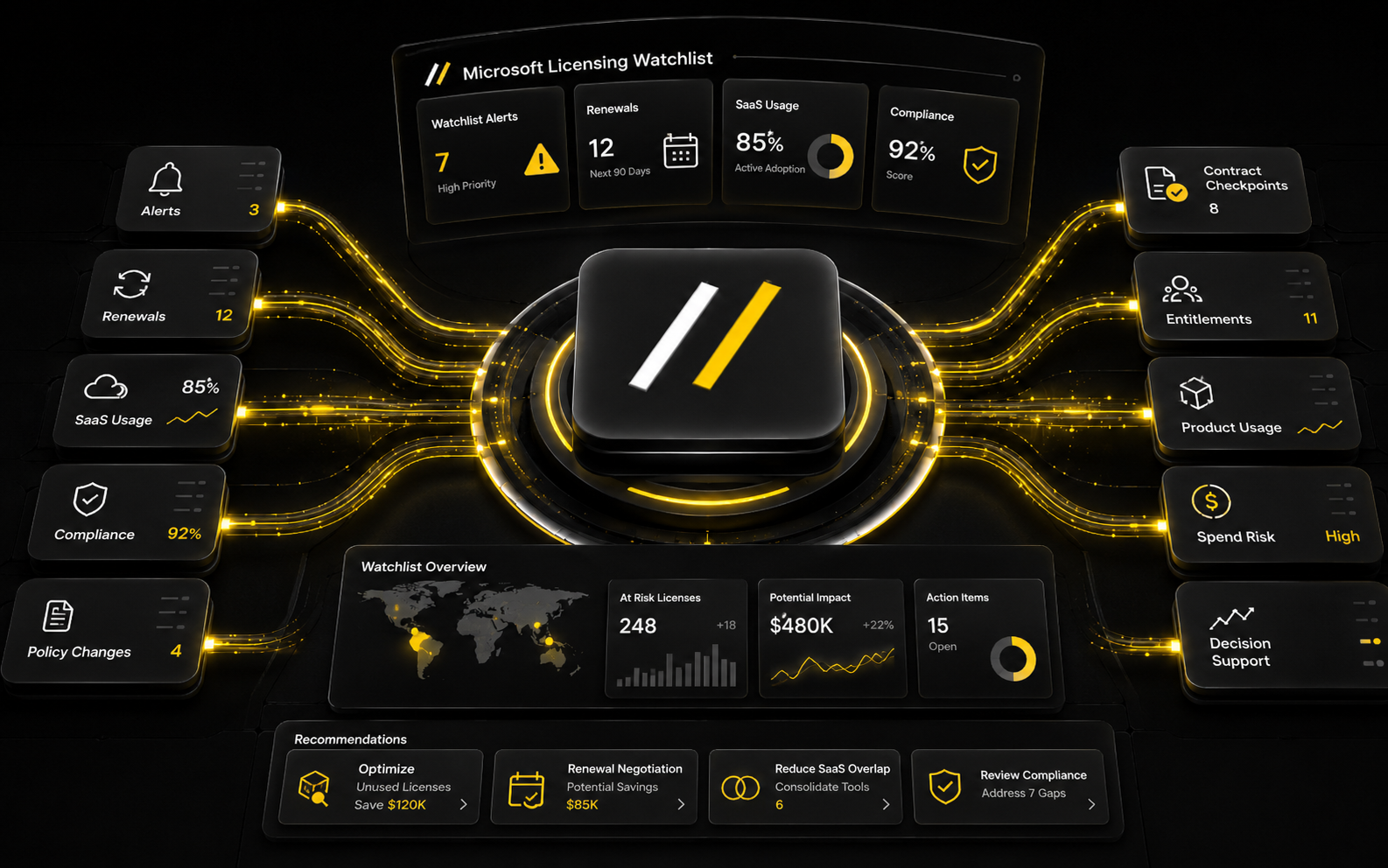
Key takeaways
- The Microsoft question in 2026 is less about one product and more about interaction across products, channels, and platform choices.
- A watchlist is useful because not every announced or emerging change becomes equally material for every customer.
- Your governance should connect commercial route, technical roadmap, and user demand in one decision log.
- Enterprise Agreement, CSP, and Azure-based commitments should not be discussed in isolation.
- If you cannot summarize your Microsoft position in a single page, you are likely carrying hidden complexity.
For most organizations, Microsoft licensing complexity comes from overlap. The issue is not just Microsoft 365, or Azure, or Teams, or Power Platform. It is the fact that each commercial choice affects another one.
The 6 watch areas
| Area | Why it matters | What to review |
|---|---|---|
| M365 packaging | Bundling choices affect per-user cost and workload entitlement. | Actual adoption by persona and duplicate capability. |
| Teams and collaboration packaging | Commercial structure may not align with inherited estate assumptions. | Who needs what, and in which geography. |
| Azure commitments | Consumption growth can outrun governance quickly. | Reserved capacity, optimization controls, and owner accountability. |
| EA vs CSP | Channel choice changes flexibility, commercial mechanics, and support posture. | Which route best fits scale and procurement model. |
| Power Platform | Low-code growth can create silent spend expansion. | Capacity, environment governance, and app ownership. |
| Server and hybrid rights | Infrastructure architecture can alter the licensing baseline. | On-prem, cloud, and hybrid deployment assumptions. |
A quarterly review model
Use a simple cadence: review the commercial route quarterly, validate demand by user persona, and reconcile that against platform roadmap. That creates a living Microsoft decision log rather than a once-a-year scramble.
Commercial
Route-to-market, term structure, price exposure, and renewal sequencing.
Operational
Adoption reality, deprovisioning discipline, and governance controls.
Architectural
Server, Azure, hybrid, and application platform choices.
Risk
Areas where entitlements, packaging, or usage have drifted apart.
Questions every team should answer
- Which user personas are over-licensed today?
- Where is adoption growing faster than governance?
- Is the current commercial route still the right one?
- Which Microsoft workloads are strategic, and which are simply inherited?
- Where does the organization need specialist support rather than internal assumption?
Final thought
A Microsoft watchlist is not about predicting every change. It is about making sure no important change catches your organization unprepared.
Quick FAQ
Who is this article for?
ITAM leaders, sourcing teams, software asset managers, procurement stakeholders, and advisors dealing with microsoft-related decisions.
Detailed PDF guide
Download the full guide
The web article gives you the concise view. The PDF includes deeper analysis, visual timelines, flowcharts, checklists, and practical review steps.
What should I do next?
Use this article to sharpen your internal brief, then submit an initiative or reach out if your team needs specialist help.
Related insights
How to Defend Publisher Audits Without Escalating Risk
A structured method for responding to audits with clean entitlement evidence, usage data, contractual boundaries, and an agreed response plan.
Oracle Licensing Complexity Explained: What Makes It Hard
A practical guide to the Oracle complexity drivers that matter most in enterprise reviews: processor cores, virtualization, Java, options, and support.
Need help turning insight into action?
The exchange is built to help teams structure the problem first—then engage the right expertise.